
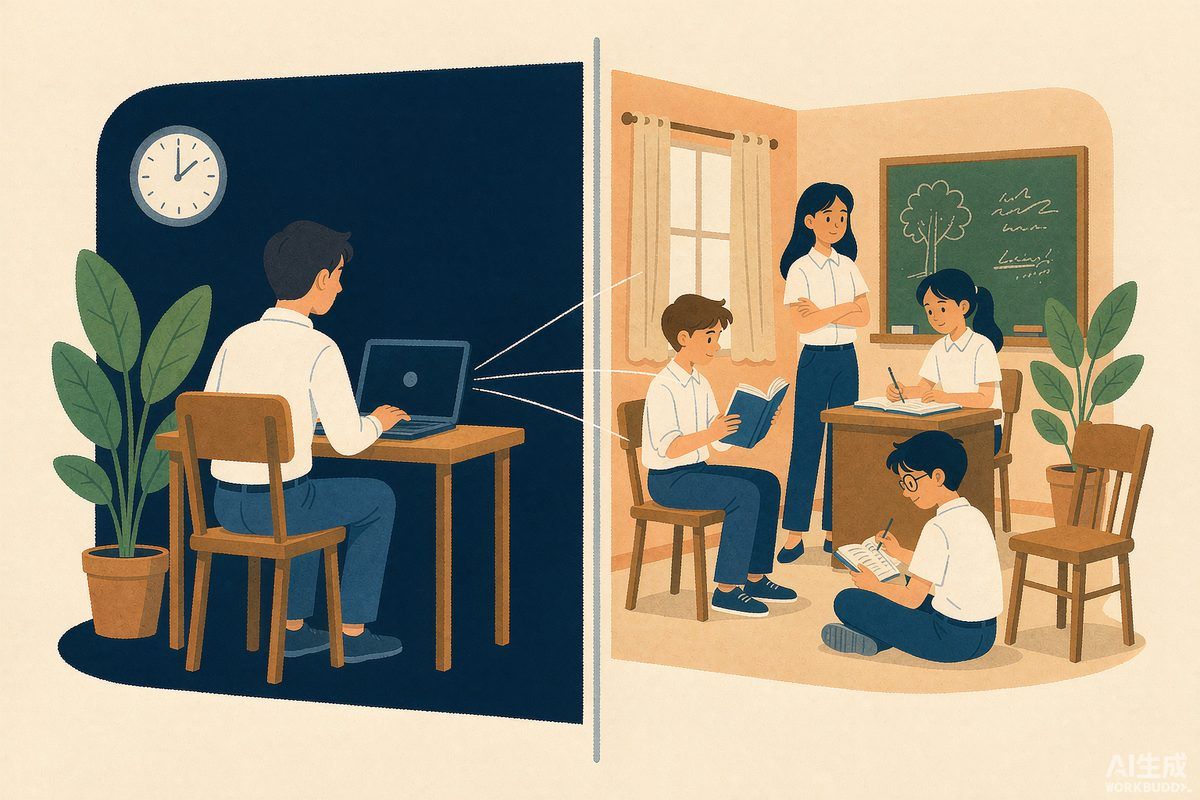
The real question is not which is better
Online and in-person Ontario high school study deliver the same credential against the same requirements. A credit earned online is an Ontario credit; it appears on the Ontario Student Transcript in the ordinary way.
So the question is not which format is superior. It is which format fits a particular student's life, and what each one costs in ways that do not appear on a course page.
CNA operates both: a fully online pathway, and a small in-person campus at 200 Town Centre Blvd in Markham, Ontario. That combination makes the comparison concrete rather than abstract.
What in-person offers that online does not
A fixed rhythm. Classes run Monday to Friday, with the campus schedule running 8:30 a.m. to 4:00 p.m. including supervised study and support. For students who need an external structure to start work, this is not a small thing — it is often the decisive factor.
Immediate access to a teacher. A question gets asked in the moment rather than written and sent. For some students, particularly those who will not email an adult, this changes everything.
A small community. The Markham campus is intentionally small. Students who find a large school overwhelming often do better in a setting where teachers know them and where classmates are recognisable.
Supervised assessment as a matter of course. Campus exams run at the end of each term, with the arrangements handled as part of the programme.
What online offers that in-person does not
No timetable. Courses are asynchronous, with no fixed daily class times. A student can study at 6 a.m. or 11 p.m., in blocks that fit work, training, performance, travel or family responsibility.
No location requirement. A student can complete Ontario credits from another province or another country without relocating.
A larger course catalogue in practice. A small campus cannot run a senior elective for two students. Online, a course runs if the student enrols; a small school's course list is limited by enrolment, not by curriculum.
The ability to combine. Many students take one or more CNA courses online while remaining registered at their own day school — solving a single prerequisite or timetable conflict without changing schools.
Replayable teaching. Recorded lessons can be paused and replayed. In mathematics and science, this is a genuine advantage over a single live explanation.
The honest trade-off
CNA states this plainly in its own materials: online study provides flexibility, with less everyday face-to-face interaction than a conventional campus experience.
That sentence describes the actual cost. Online study asks more independence of the student. Nobody notices on Tuesday that a week has passed without progress. Students who need the structure of a fixed routine — or who are still building the habit of asking for help — often do better in person, even when the content is identical.
The reverse is also true. A student who is disciplined, who reads feedback, and who will send a specific question in writing often performs better online simply because they control the schedule rather than the schedule controlling them.
Two kinds of student, two formats
Broad patterns, offered with the caveat that individuals vary:
Online tends to suit students who:
- Commit to sport, performance, training or work alongside school
- Need a prerequisite or elective their current school cannot fit or offer
- Study from outside Ontario and need an Ontario record without moving
- Have already demonstrated they can work without supervision
- Want to repeat a course without doing so in front of their current classmates
In-person tends to suit students who:
- Need a defined daily routine to begin work
- Want direct teacher contact and a small school community
- Are moving to Canada and want campus, homestay and custodianship arrangements handled together
- Have found that online study did not work previously because of structure rather than content
Practical differences to plan for
Intakes. Online enrolment is available throughout the year. Campus intakes run in September, January, May and July.
Assessment. Both formats assess against the same Ontario expectations. Campus exams take place at the end of each term; online courses that include a supervised final evaluation require booking with at least two weeks' notice and completion within the enrolment period. Online proctored sessions require a computer plus a separate phone with a working camera and microphone, a stable connection and government-issued photo identification.
Documents and arrangements. International families considering campus study should review homestay and custodianship as separate arrangements with their own confirmations, and should discuss immigration requirements based on their circumstances. Online study from abroad does not involve those arrangements.
Moving between formats. Students who want to shift from online to campus, or the reverse, should speak with Admissions about course availability and timing. The move is possible; it is not automatic in the middle of a course.
A student scenario
Grace (pseudonym), age 16, Taipei — one year online, then campus.
Grace's family planned a move to the Greater Toronto Area but the timing slipped by a year. She wanted to begin Ontario study immediately rather than lose the year, but she also wanted the campus experience once she arrived.
She started two Ontario credits online with CNA from Taipei, studying three evenings a week. The asynchronous format meant the fourteen-hour time difference never mattered — she worked on her own schedule, used recorded lessons when a concept did not land, and sent specific questions to her teachers rather than waiting for a class.
The year was more demanding than she expected in one respect: she had to build the routine herself. Her family agreed a weekly check-in, which she later described as the reason the plan held.
When she arrived in Markham the following year, she continued with campus study, taking the day-school pathway with classes from 8:30 a.m. to 4:00 p.m. Because her earlier credits were already recorded, she entered with timetable space rather than under a backlog.
She completed her diploma requirements and received offers from the University of Toronto and the University of British Columbia.
Scenario note: student vignettes in this article are composite illustrations of common pathways, not individual guarantees. Admission outcomes depend on each student's own record and on each institution's criteria and admission year.
A five-question decision
- Who starts the work if nobody tells the student to? If the answer is "nobody", in-person is likely the better fit.
- Is the problem content or scheduling? Scheduling problems are solved by online study; motivation problems are not.
- What does the student need that the current school cannot provide? A specific course code, a timetable slot, or a different environment?
- Is location fixed? If the student cannot relocate, the question is answered.
- Has the format been tested? One course is a cheap experiment. A full programme is not.
Next step
Tell Admissions what the student needs — one credit, a full diploma, or campus study — and what the constraints are. You will get a specific recommendation rather than a general one.
Contact Canada Nord Academy ↗WhatsApp +852 5318 8536 · admissions@nordeducation.com